

Bollywood News: Indian characters are now far more visible across international films and streaming shows, but how accurately do these productions capture the country they are trying to represent? A recent opinion column published by ThePrint has reignited that conversation by arguing that India is frequently reduced to a familiar collection of Bollywood dance, weddings, arranged marriages and food when represented through an overseas lens.
Is Global Indian Representation Becoming Predictable?
For decades, international cinema struggled with limited and often stereotypical depictions of Indians. Representation has improved considerably, with Indian and Indian-origin characters increasingly becoming central figures rather than appearing only in supporting roles.
But greater visibility does not automatically guarantee greater cultural depth.
ThePrint columnist Theres Sudeep argues that overseas portrayals of India continue to return to a relatively narrow group of recognisable cultural markers. Bollywood, Bharatanatyam, colourful weddings, arranged marriages and samosas are among the recurring elements highlighted in the column.
These cultural elements are genuinely Indian, of course. The debate is instead about whether repeatedly relying on them can make an extraordinarily diverse country appear culturally uniform.
India Is Much Bigger Than One Cultural Template
One difficulty with representing India internationally is its sheer diversity.
Indian identity cannot easily be compressed into a single language, cuisine, dance tradition or entertainment industry. Regional cinema itself illustrates that complexity, with Hindi, Tamil, Telugu, Malayalam, Kannada, Bengali, Marathi and numerous other industries producing stories rooted in dramatically different social and cultural environments.
The same diversity exists in food, music, clothing, festivals and everyday family traditions.
This means that an Indian character does not necessarily need to dance to a Bollywood song, attend an elaborate wedding or eat stereotypically recognisable Indian food for audiences to understand their cultural background.
From Never Have I Ever To Best Of The Best
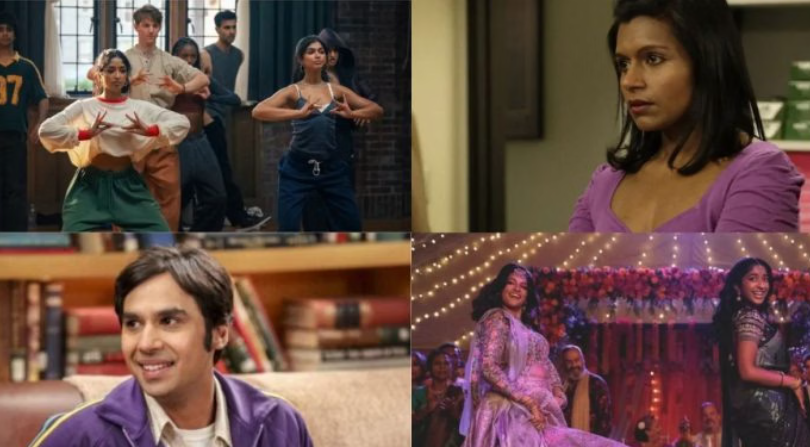
ThePrint column points to international productions including Never Have I Ever and Best of the Best while discussing how Indian culture appears in overseas storytelling. It argues that Indian representation often gravitates toward highly recognisable symbols rather than exploring the full range of contemporary Indian experiences.
That does not necessarily make these portrayals inherently inaccurate. Bollywood, dance, weddings and family expectations are all meaningful parts of life for many Indians.
The larger question is whether global entertainment has enough room for Indian characters whose identities are shaped by completely different experiences.
Why Bollywood Becomes An Easy Cultural Shortcut
Bollywood has enormous international recognition. Songs, dance sequences and colourful costumes offer filmmakers an immediately identifiable visual language for signalling “India” to audiences unfamiliar with the country.
But Bollywood itself represents only one part of Indian cinema.
The enormous growth of South Indian cinema internationally has demonstrated how many different storytelling traditions exist within the country. Malayalam cinema has gained attention for grounded storytelling, while Telugu and Tamil films have built substantial audiences beyond their traditional markets.
India's independent and regional filmmaking traditions add even more layers.
As international audiences become more familiar with these industries, overseas filmmakers also have an opportunity to move beyond the older shorthand that treated Bollywood as virtually synonymous with Indian culture.
The Arranged Marriage Storyline Keeps Returning
Marriage is another recurring theme whenever Indian families appear in international entertainment.
Arranged marriages, parental expectations and generational disagreements can provide filmmakers with accessible dramatic conflict. They are also genuine subjects within Indian society.
However, repeatedly using these themes can create the impression that marriage defines most conversations within Indian families.
Contemporary India offers countless other subjects—from education and entrepreneurship to migration, class, technology, friendships, sports, regional identity and changing relationships between generations.
Exploring these experiences could allow international productions to build Indian characters whose cultural identity feels natural rather than assembled from instantly recognisable symbols.
Authenticity Does Not Mean Removing Bollywood Or Samosas
The answer is not to eliminate Bollywood dancing, traditional clothing, weddings or Indian food from international productions.
Doing so would simply replace one artificial limitation with another.
These things are authentic parts of Indian culture for millions of people. What matters is context and variety. A Punjabi family in Delhi, a Tamil household in Chennai and a Bengali family in Kolkata may share an Indian identity while having substantially different languages, cuisines and traditions.
Showing those distinctions can make characters more specific—and specificity often makes storytelling stronger.
Indian Representation Has Already Come A Long Way
The current debate itself demonstrates how much representation has evolved.
Earlier conversations frequently centred on the absence of Indian characters or simplistic stereotypes. Today, viewers can debate which parts of Indian culture receive attention and which remain largely invisible.
That represents progress, even if there is considerable room for improvement.
Indian-origin writers, actors and filmmakers working internationally have also helped introduce audiences to experiences that previously received little mainstream screen time.
A Bigger Opportunity For NRI Filmmakers
For filmmakers from the Indian diaspora, the challenge is particularly interesting. Their stories can legitimately reflect a hybrid identity shaped by both India and the countries where they grew up.
An NRI filmmaker does not have to create a documentary-style representation of contemporary India every time an Indian character appears.
At the same time, moving beyond familiar cultural shorthand could introduce international audiences to aspects of India they rarely encounter on screen.
Bollywood dancing, Bharatanatyam performances, weddings and samosas are all part of India. They simply aren't the entirety of India.
With global audiences increasingly comfortable watching culturally specific stories, filmmakers now have greater freedom to explore the country's many languages, regions, communities and everyday experiences.
The next evolution of Indian representation may therefore be less about proving that Indian culture belongs on international screens—and more about showing just how many different versions of Indian life those screens can contain.
Click here for the latest news from Bollywood, Hollywood, South Film Industry, Bhojpuri and TV world… Click here to join the Facebook Page, Twitter Page, YouTube page, and Instagram of Bollywood Mascot!


Leave a Comment