


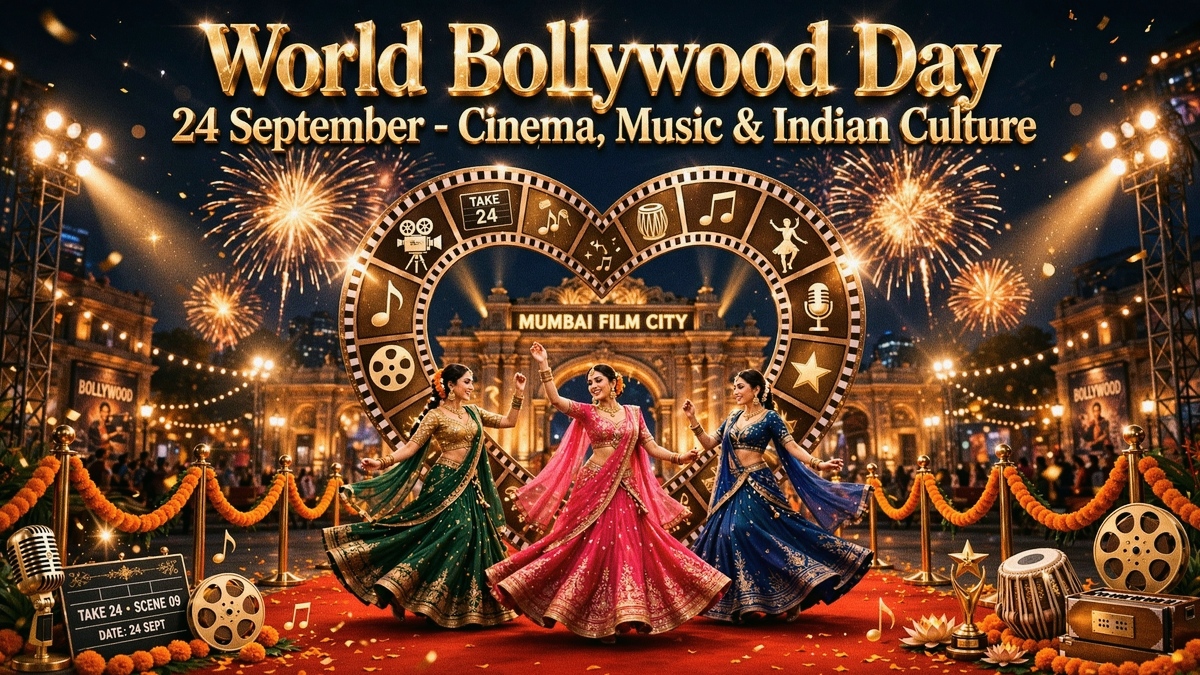
World Bollywood Day is observed on September 24 as an occasion to celebrate the international popularity and cultural influence of Hindi cinema. Bollywood has long been more than a film industry. Its songs, dance sequences, fashion, dialogues and storytelling have travelled across borders and become familiar to audiences in different parts of the world.
According to DD News, September 24 is being discussed as World Bollywood Day, highlighting the global recognition of Hindi films, music and Indian culture. However, the official international recognition of the day and its exact historical origins are not supported by extensive documented evidence. Instead, the occasion provides an opportunity to discuss Bollywood’s growing cultural presence around the world.
How Bollywood Got Its Global Identity
The term “Bollywood” is commonly used for the Mumbai-based Hindi film industry. The word is generally understood as a combination of “Bombay” and “Hollywood”. Over the decades, the term has evolved beyond simply describing film production in Mumbai.
Today, Bollywood is associated with Hindi films, stars, songs, dance, fashion and a distinctive form of popular entertainment. Mumbai remains one of the major centres of Hindi film production, bringing together actors, directors, writers, musicians, technicians and production companies.
The industry has also changed considerably over the years, moving from silent cinema to talkies, black-and-white films and eventually colour productions and digitally produced movies.
From Raja Harishchandra To Modern Bollywood
The story of Indian cinema dates back to the early 20th century. Dadasaheb Phalke’s Raja Harishchandra, released in 1913, is widely recognised as India’s first full-length feature film.
From those early beginnings, Indian cinema expanded across multiple languages and regions. Hindi cinema became one of the most prominent parts of this wider film landscape.
Over time, Bollywood developed its own style, combining drama, romance, action, comedy, music and dance. This mixture helped Hindi films connect with audiences within India while also making them accessible to viewers in other countries.
Bollywood Music Became A Global Attraction
One of the strongest elements of Bollywood’s international appeal has been its music. Hindi film songs have often become popular independently of the movies in which they appear.
Playback singing created a unique tradition in Indian cinema, turning singers into major cultural figures. Legendary voices such as Lata Mangeshkar, Asha Bhosle, Mohammed Rafi, Kishore Kumar and Mukesh shaped different generations of Hindi film music.
Their songs travelled beyond Indian cinema and became part of the cultural identity associated with Bollywood. Later generations of singers and composers continued to expand this musical influence through changing sounds, technology and collaborations.
Bollywood Dance Finds Audiences Worldwide
Dance is another major reason behind the global recognition of Bollywood. Hindi films have traditionally incorporated songs and elaborate dance sequences into their storytelling.
Bollywood dance often combines elements of Indian classical and folk traditions with contemporary choreography. Outside India, Bollywood songs are used in dance classes, workshops and cultural programmes.
In several countries, both members of the Indian diaspora and local audiences participate in Bollywood dance events. This has helped make Hindi film music and choreography a recognisable part of Indian popular culture internationally.
Hindi Films Reach Audiences Across Continents
The international audience for Bollywood has developed over several decades. South Asia, the Middle East, Africa, Europe and other regions have all witnessed audiences for Hindi cinema.
The Indian diaspora has played an important role in taking Bollywood to different parts of the world. Overseas box-office collections have also become an important component of the commercial performance of several major Hindi films.
At the same time, filmmakers have increasingly explored international locations and developed promotional and distribution strategies aimed at audiences outside India.
Raj Kapoor And Bollywood’s Early International Popularity
Raj Kapoor remains one of the most recognised examples of an Indian actor whose films developed a strong international following. His movies and songs became particularly popular in the former Soviet Union.
This international response demonstrated that Indian films could connect with audiences even when viewers did not understand the Hindi language. Emotional storytelling, music and performances helped Hindi cinema cross linguistic and geographical boundaries.
The popularity of Indian cinema in Russia became one of the early examples of Bollywood’s cultural influence beyond the Indian subcontinent.
Aamir Khan Took Bollywood To New Markets
In more recent decades, Aamir Khan’s films have contributed to the growing international profile of Hindi cinema. Movies such as 3 Idiots, Dangal and Secret Superstar attracted significant attention in overseas markets, particularly China.
These films demonstrated that stories rooted in Indian society could connect with audiences in other countries when they addressed universal themes such as education, family, ambition, determination and social expectations.
The international performance of such films also encouraged Indian filmmakers and studios to look more closely at overseas audiences.
Bollywood’s Influence On Indian Culture
The global influence of Bollywood extends beyond movies. Hindi cinema has introduced international audiences to various elements associated with Indian popular culture, including traditional clothing, weddings, festivals, food, family relationships, music and dance.
However, films represent culture through a creative lens. The portrayal of India in a Bollywood movie does not necessarily represent the country's entire social or cultural reality.
Instead, Bollywood can be viewed as an important medium through which selected aspects of Indian popular culture have reached international audiences.
Bollywood Stars Become Global Names
The international reach of Bollywood has also been strengthened by its stars. Actors such as Amitabh Bachchan, Shah Rukh Khan, Aamir Khan, Salman Khan, Akshay Kumar, Deepika Padukone and Priyanka Chopra have developed recognition beyond India.
Social media has further expanded the global visibility of Indian actors. Today, fans in different countries can follow Bollywood celebrities, watch interviews and trailers and interact with entertainment content almost instantly.
This direct digital connection has reduced the dependence on traditional television and cinema distribution for creating international awareness.
OTT Platforms Expand Bollywood’s Reach
The rise of OTT platforms has created another major opportunity for Bollywood and Indian storytelling. Streaming services allow Hindi films and series to reach viewers across multiple countries, often around the same time.
Subtitles and dubbing have also reduced language barriers. A viewer who does not understand Hindi can still experience Indian stories through translated dialogue.
This has created new opportunities for filmmakers, writers and performers to reach international audiences. Digital platforms have therefore become an important part of Bollywood’s global expansion.
Bollywood Is Changing With The Times
Bollywood itself has undergone major changes in terms of storytelling. Earlier eras were strongly associated with family dramas, romance, action and music-heavy entertainers.
In recent years, Hindi cinema has increasingly explored social issues, real-life stories, unconventional characters and new genres. Filmmakers are also experimenting with different narrative structures and production techniques.
At the same time, collaboration between Hindi cinema and regional film industries has increased, making the broader identity of Indian cinema more diverse than the term Bollywood alone suggests.
Indian Cinema On The Global Stage
Indian cinema’s international presence is no longer restricted to audiences from the Indian diaspora. Film festivals, international awards, streaming platforms and overseas markets have created additional opportunities for Indian productions.
Indian actors and technicians are also increasingly working on international projects. These collaborations are opening new professional opportunities while allowing Indian filmmaking talent to participate in global productions.
The growing international presence of Indian cinema also reflects the diversity of the country's film industries, with Tamil, Telugu, Malayalam, Kannada, Bengali, Marathi and other language cinemas gaining recognition worldwide.
Challenges For Bollywood In The Global Market
Despite its international popularity, Bollywood faces a changing entertainment landscape. Audience preferences are evolving, production costs are increasing and streaming platforms have intensified competition.
Different international markets also have different viewing habits and cultural preferences. Indian filmmakers therefore need to understand audiences beyond the traditional overseas Indian market.
Another important development is the growing global visibility of regional Indian cinema. As films from different Indian languages gain international audiences, the global identity of Indian cinema is becoming broader and more diverse.
Technology Is Creating New Opportunities
Technology is changing both filmmaking and the way audiences consume movies. Digital cameras, visual effects, artificial intelligence-based tools, virtual production and advanced post-production techniques have created new possibilities for filmmakers.
Social media has also transformed the relationship between celebrities and audiences. Actors and filmmakers can now communicate directly with viewers around the world, while trailers, songs and behind-the-scenes content can reach millions of people within hours.
These developments are likely to continue influencing how Bollywood creates and distributes content internationally.
Why World Bollywood Day Matters
World Bollywood Day provides an opportunity to look at the journey of Hindi cinema from a domestic entertainment industry to a cultural presence recognised across the world.
The occasion celebrates more than actors and films. It also highlights the role of Bollywood music, dance, fashion and storytelling in shaping perceptions of Indian popular culture.
At the same time, the limited documented information about the day’s formal international recognition means it is more appropriate to view September 24 as an occasion for celebrating Bollywood’s global cultural influence rather than as a universally established international observance.
Bollywood’s Global Journey Continues
From Raj Kapoor’s popularity overseas to the international success of contemporary Hindi films, Bollywood has travelled a long way. Its songs are performed in foreign dance studios, its stars have global fan bases and its stories are increasingly available through international streaming platforms.
As technology, OTT services and international collaborations continue to reshape entertainment, Bollywood’s global journey is also evolving.
Click here for the latest news from Bollywood, Hollywood, South Film Industry, Bhojpuri and TV world… Click here to join the Facebook Page, Twitter Page, YouTube page, and Instagram of Bollywood Mascot!



Leave a Comment